
The Social Finance Institute, Workforce & Economic Mobility, Papers
This paper is a partnership between Harry Holzer, John LaFarge Jr. SJ Professor of Public Policy at Georgetown University’s McCourt School of Public Policy, and the Social Finance Institute’s David Socolow.
In today’s labor market – defined by rapid technological change, persistent worker shortages in key industries, and growing political concern over student debt – there is renewed urgency to find more equitable and sustainable ways to finance skills training in the face of significant gaps in available funding for education and training programs.
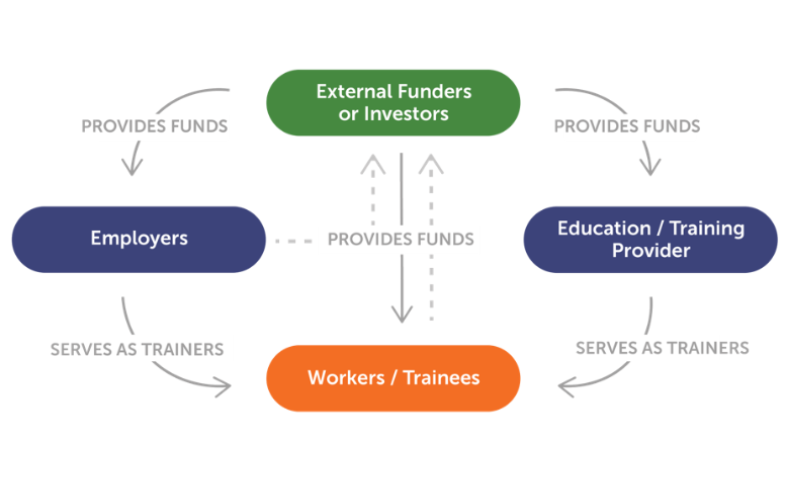
In partnership with Professor Harry Holzer, this paper explores the ecosystem of outcomes-based approaches to financing workforce education and training in the US. Building on the economic framework for investment in skills training by workers, employers, and others, the paper analyzes 33 programs in the U.S. and describes key lessons learned for outcomes-based financing to expand workers’ opportunity to earn credentials and create accountability for worker success.
Outcomes-based repayment models offer new ways to finance education and workforce training by tying repayment to participants’ post-training success. Instead of workers or employers paying for training upfront, third parties like governments, philanthropies, or impact investors cover the initial costs. Repayment is required only if trainees achieve outcomes like higher earnings or job retention. However, these initiatives face challenges around repayment compliance, participant understanding, and consumer protection.
To learn more, contact us.
|
Harry Holzer
John LaFarge Jr. SJ Professor of Public Policy, McCourt School; Nonresident Senior Fellow, Brookings
|
Harry J. Holzer is the John LaFarge Jr. SJ Professor at the McCourt School of Public Policy at Georgetown University and a nonresident senior fellow in Economic Studies at the Brookings Institution. He previously served as chief economist for the U.S. Department of Labor and professor of economics at Michigan State University. He is also an institute fellow at the American Institutes for Research, a research affiliate of the Institute for Research on Poverty at the University of Wisconsin, a research fellow at IZA, and a National Affiliate of the Center on Poverty and Inequality at Stanford University. He received his BA (1978) and PhD (1983) from Harvard University.
|
David Socolow
Head of Policy, Social Finance Institute
|
David J. Socolow is Head of Policy at the Social Finance Institute, where he leads initiatives in collaboration with policymakers, researchers, and peer learning communities to build knowledge about outcomes-based policies and practices that expand social and economic mobility. Before joining the Institute in 2024, he spent over 30 years in government and the private sector championing education and workforce success. He most recently led New Jersey’s Higher Education Student Assistance Authority. Socolow previously served as New Jersey’s Labor Commissioner and in senior roles at the U.S. Department of Labor, Pinnacle Foods, and CLASP. He holds a BA from Harvard College and an MPA from Rutgers University.