
In this interview, Jake Edwards explains why innovative financing isn’t a one‑size‑fits‑all solution — institutions must diagnose their real barriers, align incentives to student outcomes, and can even partner with employers on their most urgent workforce needs to expand economic mobility.
“Don’t treat yourself as a monolith.”
Too many institutions chase the same headline opportunities: health professions, teaching, engineering, business, and the trades (and computer science until just a few years ago). But even within your continuing education department, you may have a dozen programs each with different student profiles, costs, and outcomes. Each program has unique value to a different potential funder, whether that be an employer, a government agency, or financier.
In one initiative, Social Finance partnered with 30 employers across the Commonwealth of Massachusetts with fewer Licensed Practical Nurses (LPNs) than they needed. But those same employers had a natural pool of potential talent: Certified Nursing Assistants (CNAs), who were all making around minimum wage. CNAs can become LPNs with a 9-month program and nearly double their wages, but they often don’t have the luxury to take 9 months off of work. Social Finance subsidized employers to give CNAs time off to pursue LPN licensure with funding provided by the Massachusetts legislature and the U.S. Department of the Treasury through the American Rescue Plan Act of 2021 (ARPA).
This program works well in Massachusetts, where the Commonwealth offers free community college and the primary barrier is paid time off. But barriers vary from state to state. “Institutions need different solutions in New Jersey than in Massachusetts, and for master’s programs than for bachelor’s or certificate programs. The best solutions aren’t copy-paste across the institution.”
Social Finance brings this discipline to the next level. They set specific targets for each program and regularly redeploy resources to where they can have the greatest impact. We’ve written before about institutions building “ghost programs” and leaving them in place until the financial walls close around them. More colleges could take Social Finance’s lead and proactively adjust their program portfolios when they get data back on their impact.
“We’ve reached out to hundreds of employers for partnerships… but we’re humble about our hit rate.”
Employer partnerships only work when the talent shortage is painful enough to hit the bottom line: healthcare systems lacking nurses, school districts without dual-language teachers, construction firms without welders. Employers put it plainly: “We only get paid for every repair truck we have on the road, and we know that we don’t have enough mechanics to keep our fleet on the road. It’s pretty easy for us to do the math.” That’s the level of urgency that gets employers to the table, and to write checks.
That means institutions cannot start with the programs they want to scale and ask employers to pay for them. Instead, start with the local employers’ most urgent pain point, then ask whether your institution is well positioned to help solve it.
Employer partnerships are not just relationship-building. They’re about product-market fit.
“The AI build out is what community colleges have been waiting for.”
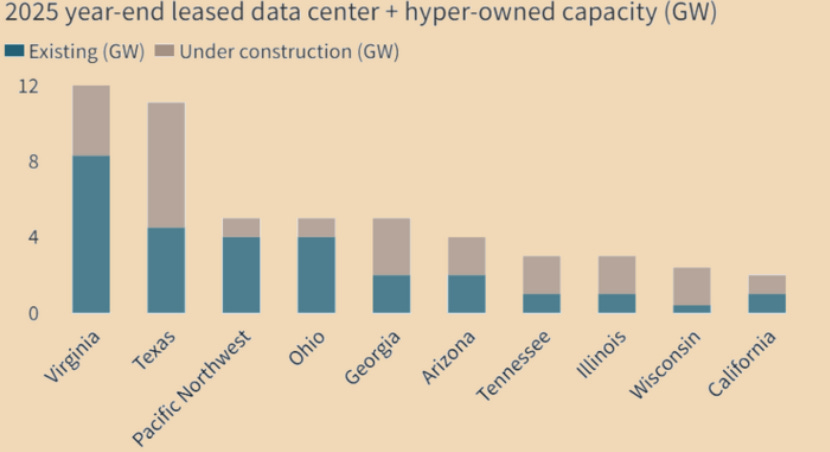
Data centers are sprouting far from the eye of the Ivory Tower.
Rural energy markets in Virginia, Texas, Ohio, and the Pacific Northwest are experiencing a generational build-out in AI data centers¹. Hyperscalers need electricians, HVAC technicians, IT and automation technicians, and dozens of other technical skills.
That demand gives community colleges a rare opening. The AI boom will not just reward PhD mathematicians in Boston and San Francisco. Across the country, the boom will produce as many as 4.7 million new short-term data center construction jobs and ~700,000 long-term operating jobs in “frontier markets” with no Ivy League or flagship state university².
This is a generational opportunity for community colleges to prepare their communities for economic mobility — high-paying jobs that don’t require a four-year degree. Now the only question is if community colleges can move fast enough to deliver on that opportunity.
“We’re incenting the wrong thing. We’re incenting people to enroll — and that’s just about it.”
Here is one of Jake’s more structural critiques, and arguably the most important one for policymakers. Public funding for higher education puts risk on the learner and rewards institutions for getting students in the door, not for what happens after.
That’s the wrong funding model for impact. Institutions should be financially aligned to persistence, completion, and job attainment, and students should only be on the hook to repay debt if they actually succeed.
Some states are already proving this is possible. Jake points to two models worth watching:
You can learn more about these examples in Workforce Realigned, Vol. II.
“Social Finance is here to listen… but we cannot solve every problem.”
Jake is clear that Social Finance is most useful when financing is the main barrier. If a program has strong ROI but students cannot access it because of upfront costs no one else is covering, innovative financing can be a solution.
Social Finance manages 8 separate Pay it Forward funds that support students to get education today and pay some or all of it back through their increased wages. Their model works because they focus on programs with proven economic outcomes and cover hidden costs of education like rent, utilities, and car repairs.
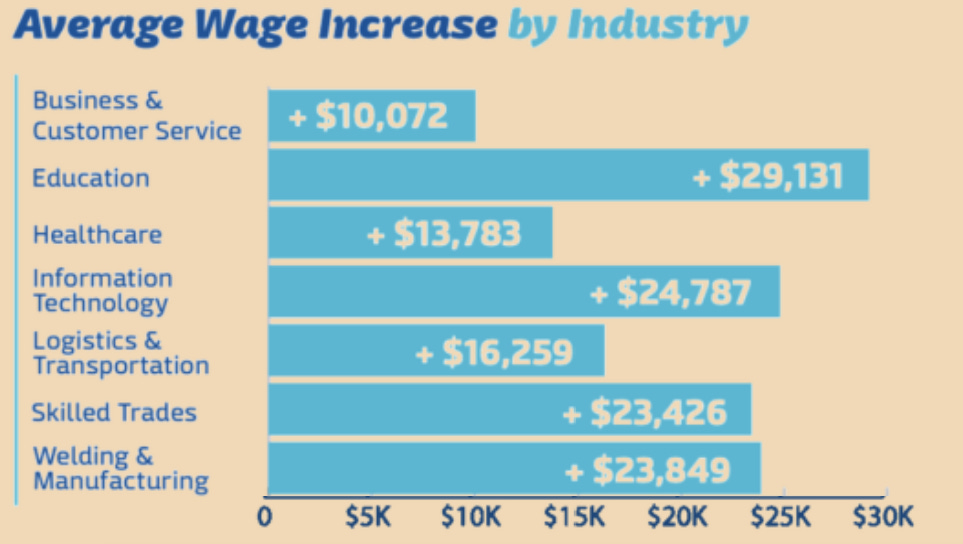
But many problems are larger and more structural. Jake laments that childcare workers “can go get a master’s degree… and your wage barely goes up.” That’s not a problem that can be solved by creative financing. Some problems require policy change. Some require employers to behave differently. Some require institutions to rethink their own operating models.
The distinction matters. Higher ed often reaches too quickly for a new program or scholarship when the real problem is more fundamental. Social Finance’s view is more disciplined: diagnose the problem first, then decide whether your tools are fit for the job.
Andrew Batson, “North America Data Center Report Year-end 2025,” JLL Insights, Accessed March 23, 2026
American Edge Project, “America’s AI Surge,” December 2025

Demystifying Program-Related Investing: Lessons from Recent Adopters is produced through a partnership between the Social Finance Institute, Wharton Impact at the University of Pennsylvania’s Wharton School of Business, and the Center for High Impact Philanthropy…